- Your personalized OfficeSign in to your Office at home or away, on PC, Mac and other select devices.
- Your settings and documents roam with you. Switch between devices and pick up right where you left off.
- Store more in the cloud. With your extra 20 GB SkyDrive storage, your notes, photos, and files are always accessible.
Simplify how you shareConnecting is easier than ever with shared calendars, real-time document editing, and calls around the world.- Keep the family organized. Stay in sync with Outlook email, shared calendars, and task-list tools.
- Easily share notebooks and files. Send a link or use free Office Web Apps to view and edit them.
- Stay in touch. Call phones in 60+ countries with 60 minutes of Skype calls each month
Turn ideas into beautiful documentsStart with a template, then polish your work with expert tools.- Work the way you want. Capture your ideas using keyboard, pen, or touchscreen.
- Work easily with media. Drag and drop images, videos, and online media into files, and pull content from PDFs straight into Word.
- Save time and stand out. Use a template from the Word or Excel Start screen, or one of the new wide-screen PowerPoint templates.
- MICROSOFT OFFICE DOWNLOAD LINKS
- Microsoft Office Xp Pro (Word, Excel, Powerpoint, Outlook, Acces)
- MICROSOFT OFFICE 2010 PRO 64+32BIT +KEY+ACTIVATOR
- MIcrosoft.office.2013.professional.plus.64.bit.with.kmspico
- microsoft.office.2013.64.bit.activated.keys.iso
Showing posts with label software engineering. Show all posts
Showing posts with label software engineering. Show all posts
Friday, 16 August 2013


HOW TO JAIL BREAK YOUR IPHONE........

What is jailbreaking?
First and foremost, let’s take a moment to remember this guide is not a guarantee you will successfully jailbreak your iPhone, iPod, or iPad. When dealing with something like a jailbreak, there is always a small chance something could go wrong with your phone, and we cannot be responsible for this. However, jailbreaking, especially with Evasi0n is extremely easy and you should be perfectly fine.
To ‘jailbreak’ your iPhone means you are freeing it from the limitations imposed by Apple. Freeing a device means that it can install applications from outside Apple’s iTunes App Store and you can fiddle with previously restricted aspects of an iOS device. Jailbreaking can also help you unlock your iPhone to make it available on other carriers.
What is Jailbreaking anyway? Is it illegal, or dangerous or something?
In buying an iProduct, you're accepting that its fate will be dictated by Apple. They control what kind of apps you install on your device, and which of the hardware functions you can exploit to their full potential. Want to install an app that Apple hasn't explicitly approved? Sorry. Want to use an app over 3G that's been designated for Wi-Fi? Nope. Want to tether your phone? Run applications in the background? Change your device theme? Install system-wide gestures? Anything that Apple hasn't approved and doesn't condone? Too bad.
Jailbreaking will free you from those bonds. Admittedly, Apple's watchful eye keeps you safe from messily coded apps that can crash your whole phone, and other craziness like that. But when you jailbreak—a completely legal thing to do—you gain entrance to a whole world of possibilities. It's a little wilder out there than it is inside the Apple company town, but as long as you're not an idiot, jailbreaking is an easy, safe, and fun adventure.
Jailbreaking will free you from those bonds. Admittedly, Apple's watchful eye keeps you safe from messily coded apps that can crash your whole phone, and other craziness like that. But when you jailbreak—a completely legal thing to do—you gain entrance to a whole world of possibilities. It's a little wilder out there than it is inside the Apple company town, but as long as you're not an idiot, jailbreaking is an easy, safe, and fun adventure.
How To Jailbreak
Jailbreaking your iPhone used to be really hard and complicated. Really, really hard and complicated. But these days it's as easy as a push of a button. Literally.Thanks to a recently released jailbreak for iOS 6.1 that covers all iPhones, iPads, and iPod Touches, you'll be able to jailbreak your device even with the freshest OS. In fact, you should make sure to have it.
The first step for jailbreaking anything—ever—is to back up your data first. Things can go wrong, and you don't want to lose everything. So make sure you sync to iTunes or iCloud before you get started. And if you want a really smooth transition, you might want to wipe your phone ahead of time. You don't have to, but it'll speed up the process.
What You Need:
- The Evasi0n Jailbreak tool for whatever OS your computer is running.
- The latest version of iTunes
- A 30 pin/Lightning cable. Whichever fits your device.
An iPad, iPhone or iPod Touch that's working and not currently jailbroken (duh).
After you've backed up your device (really, you should back up your device) all you have to do is plug it into the computer and then run the downloaded jailbreak app. You'll get a dialog box with a button labeled "Jailbreak." Click it, and then just step away from the computer while the magic happens. Don't mess with anything while it's doing its thing. After a little bit, your phone will reboot and boom, you are jailbroken.
What now?
You'll notice you've got a new app on your homescreen, the Cydia Store. This is where all the jailbreak magic happens. In the Cydia Store, you can find a wealth of apps that didn't/couldn't make it into the real App Store. These apps will let you do all kinds of stuff from changing the way your lockscreen works to changing the way your icons and UI look, along with all kinds of other functionality. And don't worry, the normal App Store and normal Apps still work too.
If you're looking for places to start exploring, the ModMyi community and Reddit's r/jailbreak are good places to start. You'll want to keep in mind that Cydia doesn't vet its apps the same way Apple does, but dangerous trash will appear as such to the keen eye, so there's not much to worry about. And when in doubt, just do some Googling. There is a lot of info out there, and plenty of people who will be glad to give you some advice if you ask nicely.
JAIL BREAK
ROOTING YOUR ANDROID DEVICE

What is rooting?
If you’re an Administrator on a Windows machine, you have access to the entire operating system and you can do whatever you like. That’s essentially what happens if you root your Android device. With root access, you can get around any restrictions that your manufacturer or carrier may have applied. You can run more apps; you can customize your device to a greater degree; and you can potentially speed it up in a variety of ways.
The process involves backing up your current software and then flashing (installing) a new custom ROM (modified version of Android).
Why would you root?
One of the most obvious incentives to root your Android device is to rid yourself of the bloatware that’s impossible to uninstall. You’ll be able to set up wireless tethering, even if it has been disabled by default. You can also access your entire file system, install special apps that require a root, and flash custom ROMs, which can add extra features and streamline your phone or tablet’s performance. A lot of people are tempted by the ability to completely customize the look of their phones. You can also manually accept or deny app permissions.
You won’t find a lot of amazing must-have apps when you root, but there are enough to make it worthwhile. For example, some apps allow you to automatically backup all of your apps and all of their data, completely block advertisements, create secure tunnels to the Internet, overclock your processor, or make your device a wireless hotspot.
Why wouldn’t you root?
There are essentially three potential cons to rooting your Android.
- Voiding your warranty: Some manufacturers or carriers will use rooting as an excuse to void your warranty. It’s worth keeping in mind that you can always unroot. If you need to send the device back for repair, simply flash the original backup ROM you made and no one will ever know that it was rooted.
- Bricking your phone: Whenever you tamper too much, you run at least a small risk of bricking your device. This is the big fear everyone has. The obvious way to avoid it happening is to follow instructions carefully. Make sure that the guide you are following works for your device and that any custom ROM you flash is designed specifically for it. If you do your research and pay attention to feedback from others, bricking should never occur.
- Security risks: Rooting may introduce some security risks. Depending on what services or apps you use on your device, rooting could create a security vulnerability. For example, Google refuses to support the Google Wallet service for rooted devices.
How to root your Android
Before you actually try to root your device, make sure that you do some reading. The best place to find discussions about rooting, guides, and custom ROMs is definitely the XDA Developers Forum. Look for a thread on your specific device and you’re sure to find a method that has worked for other people. It’s worth spending some time researching the right method for your device.
Preparation for root
You’ll want to ensure that your device is fully charged before you begin. You’ll also need to turn USB debugging on. On the Galaxy S3 you’ll find it in Menu > Settings > Developer options and then check the box next to USB debugging. You will likely be plugging your device into your computer in order to root it.
Most Android rooting methods require you to install some software on your computer. It’s likely you’ll need to install the Android SDK. You may find other software is required. Make sure you follow the instructions and install all of it before proceeding.
One-click rooting
One of the easiest methods of rooting, which also supports a long list of devices, is SuperOneClick. You’ll find clear instructions, including a video, on how to use it at this XDA Developers SuperOneClick thread.
You will need to install some software to prepare, but the actual rooting process is one click. It will only take a few minutes to complete and then you’ll need to restart your Android device.
There is software out there that claims to provide one click rooting with no extra installs, but you should not have to pay to root your device and it’s very important to be wary about the method you choose. If in doubt, do more research. The XDA Developers forum is the most trustworthy source for rooting guides.
Your specific device
The reason rooting isn’t more straightforward is that all Android devices are not created equal. There are significant differences between Android smartphones, between manufacturers, and even between carrier specific versions of the same phone model. Make sure that any rooting guide or custom ROM you intend to use does support your specific device or you are asking for trouble.
Once you have found the right guide for your phone or tablet, it’s simply a case of working through the listed steps methodically. It can be a complicated procedure and it can take a while. Here’s an example guide for rooting the Samsung Galaxy S3. It can appear intimidating at first glance, but provided you follow it step-by-step, it should be a pain-free process. You can post questions in the XDA Developers forum if you run into trouble.
To root or not to root
Gaining full root access to your Android device can be thrilling, especially if you want to tinker with settings and customize your device. How much it changes your experience depends largely on the device you have. If you have a shuttered device, like a Kindle Fire tablet, then it’s a great way to get the full Android experience.
The potential benefits for all Android users include improved battery life, root-only apps, custom ROMs, overclocking, an end to bloatware, improved performance, and the ability to upgrade your phone when you want. If you aren’t excited at the prospect of any of these things, rooting probably isn’t for you.
BEST SITE TO GET HELP
HOW TO SLIDE LOAD ANDROID APPS
What is sideloading?
“Sideloading” is just another word for installing an Android application onto your phone, from somewhere other than the Google Play Store. While this is generally a bad idea for beginners (you never know what kind of viruses you can catch on the internet), there are times when you need to test an app from a trusted developer, or even install a leaked version of something official (like a new Google Play Store, Google Maps, etc.).
Take heed. This should never be used as a way to circumvent paying for games or applications on Google Play. With Android being the most targeted mobile OS in regard to viruses and malware, stick to the Play Store if possible. This is actually one of the main reasons why Android doesn’t allow sideloading by default (but this can be turned off).
Not all Android apps come from the Google Play Store. In fact, there are a number of places on the Web where you can find safe and sometimes free apps for your Android phone. In order to install these apps, however, you're going to need to sideload them onto your device. Sideloading refers to the process that allows you to run apps on your Android phone that don't come from an official source like the Google Play Store: Most Android phones have this option disabled by default, but turning it on takes less time than ordering a hamburger at McDonald's.
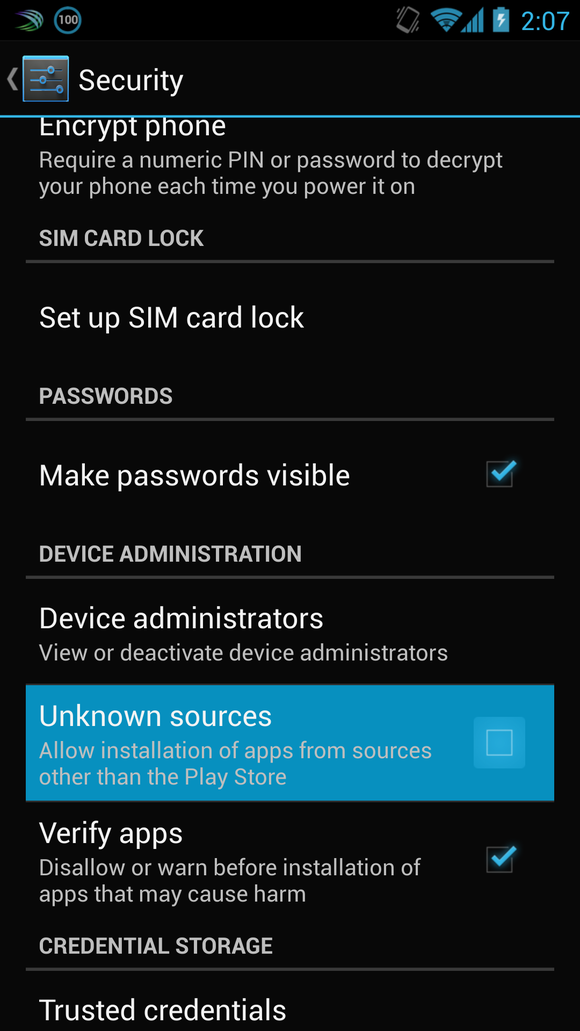
To start, open your phone's settings app and make your way to the security section. Once there, locate the option titled "Unknown Sources" and tap it to turn it on. A warning will pop up, telling you that bad stuff may happen if you allow your phone to run apps from outside the Google Play store. Confirm the prompt that pops up and presto! You can now sideload apps onto your phone by downloading app APKs—the files in which the apps live. You can install those apps by either opening them in Downloads or using an app like Easy Installer.
What can you do with your newfound super power? You'll have access to a wider range of app stores: Amazon, for example, runs one of the biggest third-party Android app stores around, and its selection is comparable to what you'd find on Google's Play Store. A nice bonus of using the Amazon App Store is that it offers a free app per day, allowing you to slowly build up your collection of apps.
If you're an avid participant in the Humble Indie Bundle, it would probably be worth your time to download and install the Humble Bundle Android app. The app keeps track of which games you've purchased and makes it easier to update them whenever a new version is released. It's not available in the Play Store so you have to sideload it (along with any Humble Bundle Android games you download).
As always, make sure you do your research before installing an app. While there are plenty of legitimate third-party app stores out there, you always run the risk of downloading something nasty onto your phone. Keep your wits about you and have fun discovering nifty new apps.
NEXUS 7 2013
The good: The Nexus 7’s razor-sharp full-HD screen, silky smooth performance, long battery life, meager weight, and affordable price make it the best tablet value on the market.
The bad: The back is missing the soft grippy texture of the original, screen colors lack accuracy, and there's no microSD support. Android 4.3 has few useful interface improvements.
The bottom line: Thanks to its stellar performance and affordable price, the Nexus 7 is the Android tablet to get.
Pound for pound, the Nexus 7 is the best small tablet you can buy. It houses a ridiculously sharp, bright screen, its gaming performance is second only to the fourth-generation iPad, and as a Google-branded tablet it will always see the latest version of Android before any other tablet brand.
Also, at $230 (for 16GB), it's still an affordable tablet with one of the highest values in the market, despite a $30 price hike over the previous generation. The $270 32GB Wi-Fi model and $350 4G LTE version are even better values, especially compared with similar configurations of the iPad Mini.
Yes, it's not as cheap as some of the top small tablets from 2012, its screen isn't as big as the iPad Mini's, and Android 4.3 lacks a few useful UI features Samsung plugged into its Galaxy Tab 3. However, those are only nitpicks considering the Nexus 7's sharp-as-nails screen and blazingly fast performance. Despite its imperfections, it's the first small tablet I'd recommend and is the current best tablet value around.
Design
At 0.64 pound, the Nexus 7 is the lightest tablet yet, and with a 4.5-inch width when held in portrait orientation, it's probably the easiest to fit in one hand. It's an extremely simple design, black in color, and it honestly lacks much in the way of panache. It's a harsher tablet compared with the original, and I miss the 2012 Nexus 7's soft, much more inviting feel.
At 0.64 pound, the Nexus 7 is the lightest tablet yet, and with a 4.5-inch width when held in portrait orientation, it's probably the easiest to fit in one hand. It's an extremely simple design, black in color, and it honestly lacks much in the way of panache. It's a harsher tablet compared with the original, and I miss the 2012 Nexus 7's soft, much more inviting feel.
The smooth matte finish of the tablet's back isn't as comfortable or as grippy as the soft leathery back of the 2012 Nexus 7. Also, the new tablet's corners aren't as pleasantly rounded and the Micro-USB port on the bottom edge sticks out just enough to be distracting when held in landscape mode.
Software features
The Nexus 7 ships with the very latest version of Android (4.3), and to be quite honest, the OS isn't much different from the previous incarnation (4.2.2). At least not obviously so. For a detailed look at the updated OS' features.The notable new features are Multi-User Restricted Profiles, OpenGL ES 3.0 support, and Bluetooth Smart. User profiles were introduced with Android 4.2, and the latest version allows you to add a kid-friendly profile that the primary profile controls. The restricted profile will only have access to apps deemed acceptable and will have no access to the Play store. It's an ideal solution for families wanting to share a single tablet; however, Google leaves the decision of implementing it up to the developer.
The Nexus 7 ships with the very latest version of Android (4.3), and to be quite honest, the OS isn't much different from the previous incarnation (4.2.2). At least not obviously so. For a detailed look at the updated OS' features.The notable new features are Multi-User Restricted Profiles, OpenGL ES 3.0 support, and Bluetooth Smart. User profiles were introduced with Android 4.2, and the latest version allows you to add a kid-friendly profile that the primary profile controls. The restricted profile will only have access to apps deemed acceptable and will have no access to the Play store. It's an ideal solution for families wanting to share a single tablet; however, Google leaves the decision of implementing it up to the developer.
OpenGL ES 3.0 improves polygonal graphics performance and allows the tablet to better handles effects like lens flares, shadows, and other shader effects. With Bluetooth Smart, the Nexus 7 can connect to a newer generation of Bluetooth devices as well as transmit metadata like song titles.
Hardware features
The 7-inch Nexus 7 houses a 1.5GHz Qualcomm Snapdragon S4 Pro system on chip with a quad-core Krait CPU and a single-core Adreno 320 GPU. It has 2GB of RAM and includes support for 802.11 a/b/g/n (2.4GHz and 5GHz) Wi-Fi, Bluetooth 4.0 (including Bluetooth Smart support), and a GPS. Additionally, a gyroscope, accelerometer, and a digital compass are included as well.
The 7-inch Nexus 7 houses a 1.5GHz Qualcomm Snapdragon S4 Pro system on chip with a quad-core Krait CPU and a single-core Adreno 320 GPU. It has 2GB of RAM and includes support for 802.11 a/b/g/n (2.4GHz and 5GHz) Wi-Fi, Bluetooth 4.0 (including Bluetooth Smart support), and a GPS. Additionally, a gyroscope, accelerometer, and a digital compass are included as well.
NEXUS 7 2012
Stunning 7” display
With a stunning 7-inch display, all day battery life, even more storage, and mobile data to keep you connected, Nexus 7 is the perfect travel or commute companion.Speed and performance
Nexus 7 is built by ASUS and comes with a NVIDIA® Tegra® 3 quad-core processor so everything is faster – pages load quickly, gameplay is smooth and responsive, and running multiple apps is a breeze. Patented 4-PLUS-1™ design gives you processing power when you need it, and battery saving efficiency when you don’t.Designed with gaming in mind
Nexus 7 was designed with gaming in mind. With heart pounding quad-core performance, a vibrant 1280-by-800 high-resolution display, and sensors like a gyroscope and accelerometer – do a barrel roll, then tilt, touch and tap your way to the top of the leaderboards while exploring over 700,000 apps and games available on Google Play.Less charging, more doing
With over 9 hours of HD video playback, 10 hours of web browsing or e-reading, and up to 300 hours of standby time, Nexus 7 can go the distance. Whether you measure battery life in chapters read, levels completed, movies watched or minutes of backseat silence, you can spend less time charging and more time doing.Made for Google Play
Nexus 7 was made for Google Play, putting all the entertainment you love right in your hand: the world's largest collection of eBooks, millions of songs, thousands of movies and TV shows, and the latest magazines – plus over 700,000 apps and games.No wires, no hassle
Forget about cables and syncing. Google Play stores all your digital content in the cloud so it’s instantly available and you can pick up right where you left off.Millions of eBooks
With over 4 million titles to choose from, Nexus 7 gives you access to the world’s largest collection of eBooks. As thin as a paperback book, Nexus 7 is portable enough to fit in back pockets and purses, and lets you customize your reading experience by adjusting the font, switching to day or night mode, and much more.700,000 apps and games
Get all the apps and games you love on Nexus 7 – with over 700,000 titles to choose from, Google Play has something for everyone. From games for the kids to the latest 3D epics, you’ll find the most popular free and paid apps and games on Google Play.Explore Google Play
Google Play puts all your favorite entertainment right in your hand. Explore millions of songs, thousands of HD movies and TV shows, and the latest magazines on Nexus 7.Best of Google
Nexus 7 comes with all your favorite Google Apps – like Gmail, Chrome, Google+ and YouTube – putting the best of Google in the palm of your hand.
Live in the Now
Google Now brings you just the right information at just the right time. It shows you how much traffic to expect before you leave for work, or when the next train will arrive as you’re standing on the platform.
With the latest version, Google Now keeps you even more organized – get reminders about upcoming flights, restaurant reservations, and hotel confirmations – when and where you need them.
With the latest version, Google Now keeps you even more organized – get reminders about upcoming flights, restaurant reservations, and hotel confirmations – when and where you need them.
Sign in. Stay synced
Nexus 7 is fully connected to Google’s reliable cloud services – so your contacts, Gmail, calendar, photos, music, movies, and books are always backed up in the cloud, no wires needed. Just sign in with your free Google Account and you’ll never lose the things that matter most.

Browse the web Chrome fast.
Nexus 7 comes with the speed and simplicity of Google Chrome, built in. Sign in to sync your bookmarks, view tabs you have open on your computer, send web pages from your computer to your tablet, and more. Browsing the web from your tablet has never been faster – pages load in a snap and hardware-accelerated rendering lets you experience the web, Chrome fast.

Gmail, to go
Gmail is better than ever on Nexus 7. Intuitively swipe back and forth between email threads so you can read and respond quickly and fly through your inbox – and all your email syncs automatically from your Nexus 7 to your phone and computer.

Google+ Hangouts
Nexus 7 lets you video chat with up to nine friends at once with Google+ Hangouts. You’ll look great with the 1.2MP front-facing camera, and starting a Hangout is a snap – on WiFi or on mobile network data.

YouTube in HD
Bring millions of videos from YouTube anywhere you go, ready to watch in the palm of your hand. With Nexus 7, videos on YouTube are available in vibrant high-definition. Watch music videos and celebrity exclusives from upcoming and popular artists right on your Nexus 7.
Industrial Infrastructure Security Flaws Pile Up
Three presentations scheduled to take place at the Black Hat computer security conference in Las Vegas today will reveal vulnerabilities in control systems used to manage energy infrastructure such as gas pipelines. These are just the latest sign that such systems remain dangerously susceptible to computer attacks that could have devastating consequences; and although the researchers proposed fixes for each flaw they’ve identified, they caution that, on the whole, industrial infrastructure remains woefully vulnerable.
The vulnerabilities add to a growing list of problems identified due to a recent surge in research into the security of industrial systems. Progress to fix such security issues has been slow going, due partly to the poor design of existing systems, and partly to a lack of strong incentives to fix the flaws quickly.
One demonstration today will spray the audience with water from a replica water plant component forced to overpressurize. Another will show how wireless sensors commonly used to monitor temperatures and pressures of oil pipelines and other industrial equipment could be made to give false readings that trick automatic controllers or human operators into taking damaging action. A third talk will detail flaws in wireless technology used in 50 million energy meters across Europe that make it possible to spy on home or corporate energy use and even impose blackouts.
U.S. officials have frequently warned that vulnerabilities in industrial control systems could permit damaging attacks on public infrastructure resulting in power outages, environmental damage, or even loss of life (see “U.S. Power Grids a Hacking Target”).
All the attacks to be mentioned today require significantly fewer resources and skill than what was required to employ the best-known attack on an industrial system, the U.S.-Israeli-backed Stuxnet operation against the Iranian nuclear program (see “New Malware Brings Cyberwar One Step Closer”).
“We have demonstrated a few scenarios that will cause a catastrophic breakdown—a pipe to burst or tank to overflow—while sending a completely different view to the controller,” says Brian Meixell of Texas security company Cimation, who brought the replica water plant component to show off the vulnerabilities he discovered.
With colleague Eric Forner, Meixell exploited a protocol called Dbus that has been used to control industrial equipment since the 1970s and is still in wide use today on devices often connected directly to the Internet. Scans of public IP addresses have revealed that at least 90,000 industrial control devices are online and vulnerable to that type of attack, says Forner (see “What Happened When One Man Pinged the Whole Internet”). Dbus is insecure because no one in the industry that uses it thought it was a priority to make it secure, says Meixell.
Lucas Apa, a researcher with IOActive, says this attitude also underpins the flaw he and colleague Carlos Mario Penagos found in wireless sensors that are used to monitor oil, water, nuclear, and natural gas infrastructure. The three leading suppliers of those sensors designed them so that they can be made to give spoof readings, or even be shut down with a relatively cheap 40-mile-range radio transmitter, says Penagos. “We can show total shutdown of the plant,” he says.
That problem—and the one discovered by the Cimation team—is now known to the companies that make the equipment, and to the industrial and infrastructure companies that buy them, thanks to a data-sharing program run by the Department of Homeland Security. That program, called ICS-CERT, for Industrial Control System Cyber Emergency Response Team, shares newly published data on vulnerabilities with affected companies and industrial operators.
However, just because ICS-CERT highlights a problem doesn’t mean it gets fixed promptly.
Apa says he expects many sensors will remain vulnerable to his wireless attack despite ICS-CERT’s action because fixing it requires physically connecting to the sensors to upgrade their software. “Because the devices are used on hazardous places, it can be very hard to grab them,” he says, and some companies will have many hundreds of sensors or more.
Sameer Bhalotra, the former senior director for cybersecurity at the Obama White House and now chief operating officer of Web security company Impermium, told MIT Technology Review that although the ICS-CERT functions well, it doesn’t speed the progress in industrial security. In contrast, software companies such as Microsoft have become adept at rapidly patching vulnerabilities, to the point where major flaws are now rare, says Bhalotra. Companies that make industrial control equipment and software have never had to worry much about security, and so they’re not capable of generating patches quickly, or making significant design changes. “Nothing well organized is happening today,” he says. “Vendors are just going to have to get faster and better at patching, and that’s going to take some time.”
One reason the process is so slow is a lack of clear incentives, says Bhalotra. Current law doesn’t make energy operators or the manufacturers of control systems liable for the consequences of poor security, such as damage caused by an explosion or a lengthy power outage. Only the introduction of new legislation to clear up the liability issue is likely to speed the evolution of more secure industrial control systems, says Bhalotra.
The vulnerabilities add to a growing list of problems identified due to a recent surge in research into the security of industrial systems. Progress to fix such security issues has been slow going, due partly to the poor design of existing systems, and partly to a lack of strong incentives to fix the flaws quickly.
One demonstration today will spray the audience with water from a replica water plant component forced to overpressurize. Another will show how wireless sensors commonly used to monitor temperatures and pressures of oil pipelines and other industrial equipment could be made to give false readings that trick automatic controllers or human operators into taking damaging action. A third talk will detail flaws in wireless technology used in 50 million energy meters across Europe that make it possible to spy on home or corporate energy use and even impose blackouts.
U.S. officials have frequently warned that vulnerabilities in industrial control systems could permit damaging attacks on public infrastructure resulting in power outages, environmental damage, or even loss of life (see “U.S. Power Grids a Hacking Target”).
All the attacks to be mentioned today require significantly fewer resources and skill than what was required to employ the best-known attack on an industrial system, the U.S.-Israeli-backed Stuxnet operation against the Iranian nuclear program (see “New Malware Brings Cyberwar One Step Closer”).
“We have demonstrated a few scenarios that will cause a catastrophic breakdown—a pipe to burst or tank to overflow—while sending a completely different view to the controller,” says Brian Meixell of Texas security company Cimation, who brought the replica water plant component to show off the vulnerabilities he discovered.
With colleague Eric Forner, Meixell exploited a protocol called Dbus that has been used to control industrial equipment since the 1970s and is still in wide use today on devices often connected directly to the Internet. Scans of public IP addresses have revealed that at least 90,000 industrial control devices are online and vulnerable to that type of attack, says Forner (see “What Happened When One Man Pinged the Whole Internet”). Dbus is insecure because no one in the industry that uses it thought it was a priority to make it secure, says Meixell.
Lucas Apa, a researcher with IOActive, says this attitude also underpins the flaw he and colleague Carlos Mario Penagos found in wireless sensors that are used to monitor oil, water, nuclear, and natural gas infrastructure. The three leading suppliers of those sensors designed them so that they can be made to give spoof readings, or even be shut down with a relatively cheap 40-mile-range radio transmitter, says Penagos. “We can show total shutdown of the plant,” he says.
That problem—and the one discovered by the Cimation team—is now known to the companies that make the equipment, and to the industrial and infrastructure companies that buy them, thanks to a data-sharing program run by the Department of Homeland Security. That program, called ICS-CERT, for Industrial Control System Cyber Emergency Response Team, shares newly published data on vulnerabilities with affected companies and industrial operators.
However, just because ICS-CERT highlights a problem doesn’t mean it gets fixed promptly.
Apa says he expects many sensors will remain vulnerable to his wireless attack despite ICS-CERT’s action because fixing it requires physically connecting to the sensors to upgrade their software. “Because the devices are used on hazardous places, it can be very hard to grab them,” he says, and some companies will have many hundreds of sensors or more.
Sameer Bhalotra, the former senior director for cybersecurity at the Obama White House and now chief operating officer of Web security company Impermium, told MIT Technology Review that although the ICS-CERT functions well, it doesn’t speed the progress in industrial security. In contrast, software companies such as Microsoft have become adept at rapidly patching vulnerabilities, to the point where major flaws are now rare, says Bhalotra. Companies that make industrial control equipment and software have never had to worry much about security, and so they’re not capable of generating patches quickly, or making significant design changes. “Nothing well organized is happening today,” he says. “Vendors are just going to have to get faster and better at patching, and that’s going to take some time.”
One reason the process is so slow is a lack of clear incentives, says Bhalotra. Current law doesn’t make energy operators or the manufacturers of control systems liable for the consequences of poor security, such as damage caused by an explosion or a lengthy power outage. Only the introduction of new legislation to clear up the liability issue is likely to speed the evolution of more secure industrial control systems, says Bhalotra.
Tuesday, 5 February 2013
Alexa rank
ALEXA RANK
Alexa Rank is a relative
measurement on
how popular a web site among the Internet community. Alexa is relative because
it depends on the data of Alexa Toolbar users. And also Alexa Toolbar is only for Internet Explore which means it doesn’t count growing group firefox fans or any other browser users. But there are
over 10 million Alexa Toolbar users who make it a recognized measurement
·
The traffic rank
is based on three months of aggregated historical traffic data from millions of
Alexa Toolbar users and data obtained from other, diverse traffic data sources,
and is a combined measure of page views and users (reach). As a first step,
Alexa computes the reach and number of page views for all sites on the Web on a
daily basis. The main Alexa traffic rank is based on a value derived from these
two quantities averaged over time (so that the rank of a site reflects both the
number of users who visit that site as well as the number of pages on the site
viewed by those users). The three-month change is determined by comparing the
site's current rank with its rank from three months ago.
·
Reach measures
the number of users. Reach is typically expressed as the percentage of all
Internet users who visit a given site. So, for example, if a site like
yahoo.com has a reach of 28%, this means that of all global Internet users
measured by Alexa, 28% of them visit yahoo.com. Alexa's one-week and
three-month average reach are measures of daily reach, averaged over the
specified time period. The three-month change is determined by comparing a
site's current reach with its values from three months ago.
·
Page views
measure the number of pages viewed by site visitors. The page views per user numbers are
the average numbers of unique pages viewed per user per day by the visitors to
the site.
·
The Trend graph
shows you the site's daily traffic rank, charted over time. The daily traffic
rank reflects the traffic to the site based on data for a single day. In
contrast, the main traffic rank shown in the Alexa Toolbar and elsewhere in the
service is calculated from three months of aggregate traffic data.
·
The movers and
shakers list is based on changes in average reach (numbers of users). For each
site on the net.they compute the average weekly reach and compare it with the
average reach during previous weeks. The more significant the change, the
higher the site will be on the list
·
They then normalize the data on demographic distribution of site visitors. Geographical distribution as such to represent those who do not use Alexa toolbar
Alexa rank
·
Google.com.pk 138 alexa rank
·
Dawn news 4017 alexa rank
·
Olx.com.pk 1627 alexa rank
·
Ilmkidunya.com.pk 12197 alexa rank
·
Rozee.pk 4090 alexa rank
Saturday, 6 October 2012
BS(CS) FUTURE IN PAKISTAN
BS(CS)
BSCS a bachelor in computer sciences future looks very bright with ever increasing demand in private and public sector as government is taking step to digitize there systems but on the other hand so do are the students in IT education.Attracting a lot of female student due to office environment.So competition is increasing day by day it is not all about cgpa. Skill is very important and it wont be wrong to say that skill is everything.GPA will only take you to the door step after that its your skill your administrative qualities your ability to communicate and team work that will get you to your desired goal.You have to be creative trust worthy and determent to make something out of your self as a bs(cs) graduate.


Subscribe to:
Posts (Atom)